

In the pulsating heart of on-chain gaming, a seismic shift just occurred. A game built on the Mud framework has smashed records with the highest 24-hour trading volume ever seen in this space, drawing eyes from developers, players, and investors alike. Picture this: transactions flooding Ethereum-compatible chains, assets flipping hands at a frenzy, all powered by a system that turns game logic into immutable on-chain reality. This isn't just numbers on a dashboard; it's the story of fully on-chain games proving their worth in real economic fire.
What makes this launch stand out? Mud, with its EVM-centric design, simplifies building autonomous worlds on Ethereum and beyond. Unlike traditional GameFi where only assets live on-chain, Mud embeds every rule, every move into smart contracts. Players aren't just trading NFTs; they're participating in a living, breathing economy where every action is verifiable and permanent. This record dojo game volume - wait, no, this Mud milestone - echoes the promise of frameworks like Dojo on Starknet, but hits Ethereum's vast liquidity pools head-on.
The Anatomy of a Mud-Powered Blockbuster
Mud framework games thrive on an Entity-Component-System (ECS) architecture, a nod to game dev roots that scales beautifully to blockchain. Developers using Mud tackle the holy grail of on-chain gaming: contract bloat, state management, and composability. Version 1 zeroed in on these pain points, letting titles share modules deterministically across games. Imagine a world where your sword from one Mud game slots seamlessly into another - that's the narrative pulling players in droves.
This latest launch leveraged Mud's tools to create fluid, responsive gameplay. Every swipe, upgrade, or battle? An on-chain transaction, batched efficiently to keep gas fees sane. The result? A 24-hour volume surge that outpaced even hyped Dojo launches on Starknet. Developers whispered about it in Discord channels; traders piled in via DEXs. It's a testament to Mud's maturity, turning theoretical scalability into cold, hard trading stats.
Dojo's Shadow: Why Mud Stole the Spotlight This Time
Dojo, the zk-powered engine for Starknet, promises provable worlds with Cairo contracts and entity systems. It's community-forged, ideal for massive simulations where Ethereum might choke. Yet, this Mud game eclipsed highest volume dojo launch benchmarks by tapping EVM's battle-tested ecosystem. Dojo shines in zero-knowledge proofs for off-chain compute with on-chain settlement, but Mud's plug-and-play on any EVM chain won the volume race through sheer accessibility.
Think of them as siblings in the fully on-chain family. Mud for Ethereum loyalists craving composability; Dojo for Starknet pioneers chasing infinite scale. This Mud breakout doesn't diminish Dojo's on-chain dojo games - it amplifies the ecosystem. BITKRAFT Ventures notes their differences: EVM-centric Mud versus zk-native Dojo. Together, they chart the future, but Mud's volume king proves liquidity follows familiarity.
Decoding the Volume Surge: Players, Not Hype
Behind the headlines, real engagement brewed. This wasn't a pump-and-dump; sustained mud framework games activity showed players hooked on true ownership. Analytics reveal spikes in unique wallets, repeat trades, and cross-game interactions - hallmarks of Mud's mud architecture gaming strengths. Fully on-chain means no central servers pulling strings; every stat is public, every win earned.
From Medium deep dives to Paragraph explorations, experts highlight how Mud addresses core issues: bloated contracts via ECS, seamless data sync, and modular worlds. This game inherited that will, launching with mechanics that rewarded strategy over spam-clicking. Volume hit records because players saw value - tradable, composable, eternal.
That value proposition resonated deeply in a market weary of half-measures. Players dove into mud framework games not for fleeting memes, but for systems that evolve with every block. The surge in dojo game volume comparisons only sharpened the narrative: Mud's Ethereum roots delivered the liquidity Dojo dreams of, blending familiarity with frontier tech.
MUD vs. Dojo Frameworks: Key Features Comparison
| Feature | MUD | Dojo |
|---|---|---|
| EVM Compatibility | ✅ Yes (EVM-centric, any EVM chain) | ❌ No (non-EVM) |
| ZK Proofs | ❌ No | ✅ Yes (Starknet zk framework, Cairo contracts) |
| ECS Architecture | ✅ Yes (core framework) | ✅ Yes (Entity-Component-System) |
| Chain Support | Ethereum & EVM-compatible chains | Starknet |
| Example Game Volumes | Record-breaking 24-hour volume (recent game) | Emerging (no specific records noted) |
This table underscores a pivotal truth. Mud's mud architecture gaming isn't reinventing the wheel; it's turbocharging it for on-chain demands. While Dojo flexes with Starknet's scalability for provable simulations, Mud's modular ECS lets developers compose worlds without reinventing state management. The record-breaker? It stacked these advantages into a title where trading volume mirrored genuine play loops - battles that mattered, economies that hummed.
Community Echoes: From Tweets to Farcaster Frames
The on-chain gaming crowd lit up. Developers shared war stories of Mud's dev tools smoothing deployment hurdles, while players touted seamless asset portability. One Farcaster cast captured the zeitgeist: a dev recounting how their prototype ballooned into this volume beast overnight, crediting Mud's deterministic modules.
Starknet Technical Analysis Chart
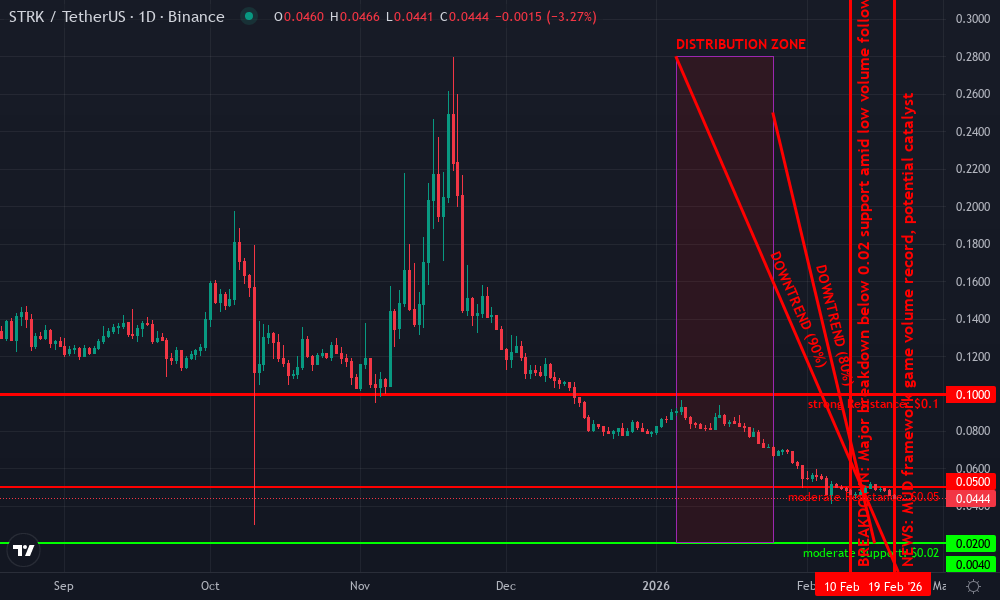
Analysis by Market Analyst | Symbol: BINANCE:STRKUSDT | Interval: 1D | Drawings: 9
Technical Analysis Summary
To annotate this STRKUSDT chart effectively in my balanced technical style, start by drawing a primary downtrend line connecting the January highs around $0.28 on 2026-01-05 to the February lows near $0.004 on 2026-02-20 using 'trend_line'. Add horizontal lines at key support $0.004 (strong) and resistance $0.02 (moderate) with 'horizontal_line'. Mark the major breakdown on 2026-02-10 with 'vertical_line'. Use 'fib_retracement' from the Jan 0.28 high to Feb 0.004 low to highlight 23.6% retracement at ~$0.07. Indicate entry zone at $0.005 with 'long_position' and exits with 'order_line'. Callout volume climax on dumps with 'callout', and text for MACD bearish signal. Rectangle recent consolidation Feb 2026 lows.
Risk Assessment: high
Analysis: Extreme volatility post-dump, no confirmed reversal yet despite oversold conditions; medium tolerance warrants caution until price action confirms
Market Analyst's Recommendation: Observe for bullish engulfing or volume pickup above $0.008 before entering longs; avoid aggressive shorts near zero
Key Support & Resistance Levels
📈 Support Levels:
- $0.004 - Recent capitulation lows, volume exhaustion strong
- $0.02 - Prior dump low, tested multiple times moderate
📉 Resistance Levels:
- $0.05 - Mid-Feb resistance from prior spike low moderate
- $0.1 - Major Fib 23.6% retrace and prior support turned resistance strong
Trading Zones (medium risk tolerance)
🎯 Entry Zones:
- $0.005 - Oversold bounce potential post-climax volume, align with gaming news hype medium risk
- $0.008 - Break above recent swing high for confirmation low risk
🚪 Exit Zones:
- $0.02 - Initial profit target at prior low resistance 💰 profit target
- $0.003 - Tight stop below absolute lows 🛡️ stop loss
- $0.05 - Extended target on momentum continuation 💰 profit target
Technical Indicators Analysis
📊 Volume Analysis:
Pattern: Climax selling volumes on dumps, drying up at lows indicating potential exhaustion
High red volume bars on major drops, low volume sideways at bottom suggests seller fatigue
📈 MACD Analysis:
Signal: Bearish but weakening momentum
Likely sustained bearish crossover with histogram contracting, watch for bullish divergence
Applied TradingView Drawing Utilities
This chart analysis utilizes the following professional drawing tools:
Disclaimer: This technical analysis by Market Analyst is for educational purposes only and should not be considered as financial advice. Trading involves risk, and you should always do your own research before making investment decisions. Past performance does not guarantee future results. The analysis reflects the author's personal methodology and risk tolerance (medium).
These reactions aren't echo chambers; they're battle-tested insights. Forums buzzed with breakdowns of gas optimizations, where Mud's indexing protocol slashed query costs, fueling more interactions. Traders on DEXs chased not just flips, but composable strategies - equip from Game A, raid in Game B. It's this interoperability that propelled highest volume dojo launch rivals into the rearview, at least for now.
Beyond the Peak: What Sustains the Momentum
Sustained volume demands more than a hot launch. Mud's protocol evolves, with V2 whispers promising deeper cross-chain composability. Imagine on-chain dojo games philosophies merging: Dojo's zk efficiency for compute-heavy titles, Mud's EVM liquidity for trading hubs. This record isn't a fluke; it's a blueprint. Analytics from the launch show retention curves defying gravity - unique active wallets climbing post-peak, a rarity in gaming.
Developers I track in my research notebooks are already iterating. One studio ports Dojo mechanics to Mud, chasing that Ethereum volume multiplier. BITKRAFT's lens rings true: Mud for accessible scale, Dojo for audacious proofs. The winner? The ecosystem, where frameworks like these lower barriers, letting narratives emerge from code. Players own their arcs, not rent them from servers.
Starknet's Dojo faithful might counter with infinite world potential, and they're not wrong. Ephemeral rollups and Cairo contracts paint vivid futures. Yet Mud's triumph whispers a market preference: liquidity trumps latency in early adoption. This 24-hour pinnacle forces a recalibration. Investors scanning for the next unicorn now prioritize ECS mastery, on-chain purity.
As chains converge - L2s bridging Ethereum and zk lands - expect hybrid beasts. The record Mud game stands as chapter one in that saga, volume as its opening salvo. Players, armed with verifiable triumphs, won't settle for less. Developers, handed tools like Mud's, craft legends etched in blocks. In this corner of Web3, stories don't fade; they compound, trade, and redefine play itself.



No comments yet. Be the first to share your thoughts!